The request came in the way these always do: "can you build us an app?" The answer, after watching how they actually worked for two days, was no — they did not need an app. They needed to stop typing the same paragraph forty times a week.
What the process actually looked like
Not the version in the manual. The real one, timed with a stopwatch:
- 1A request arrives by WhatsApp or phone. Someone writes the details on paper.
- 2That person opens last month's quote in Word, saves a copy, and edits the client name, the items and the prices.
- 3Prices are checked against a spreadsheet that lives on one laptop.
- 4The document is exported to PDF, renamed, and sent back by WhatsApp.
- 5The quote is copied into a second spreadsheet so someone can follow up later. Usually nobody does.
Forty minutes per quote on average, and about ninety percent of the content was identical every time. The remaining ten percent — the items, the quantities, the discount — was the only part that needed a human.
What we built
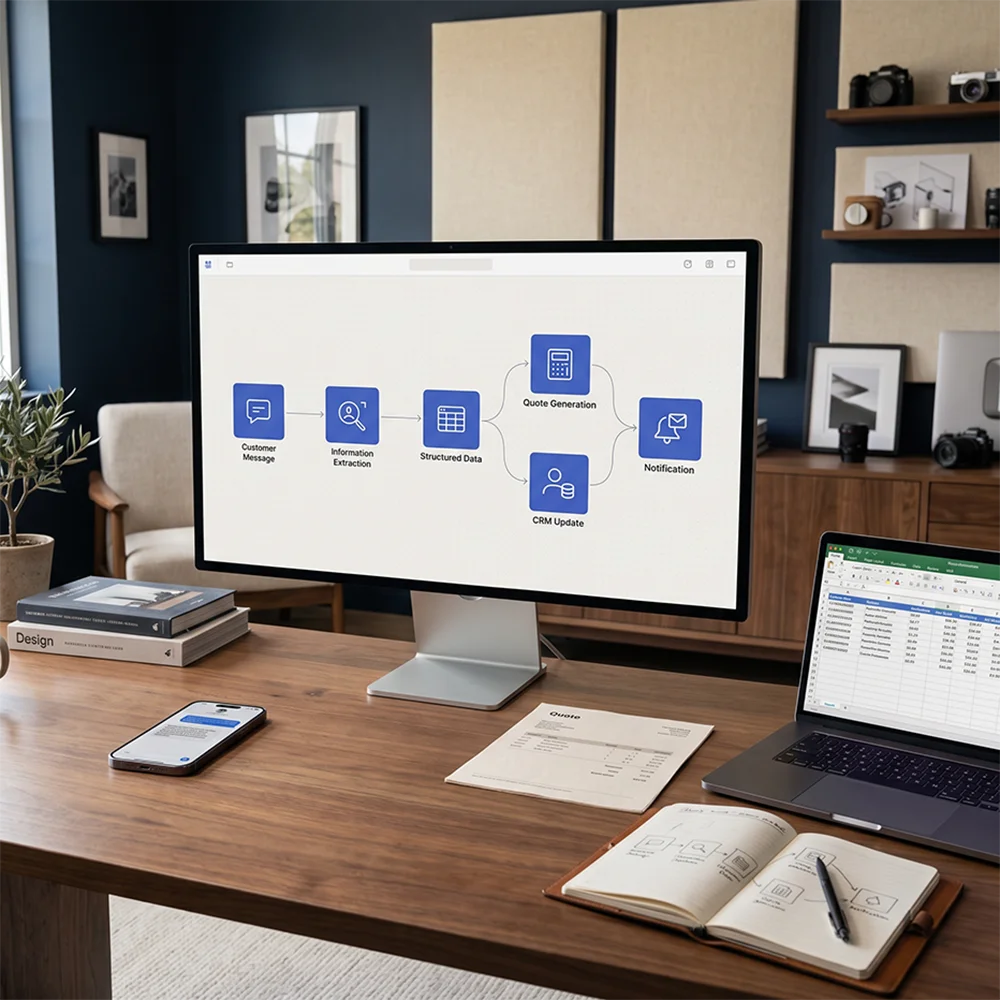
A form the team fills in on their phone — client, items, quantities, discount. Nothing else. Behind it:
- Prices are read from the spreadsheet they already maintain. No migration, no new database, no "you have to learn this system now".
- The quote is generated as a PDF using their own template, with their own layout and stamp.
- It is sent automatically to the client by email and WhatsApp, with a message someone can still edit before it goes.
- Every quote is logged in a sheet with its status, and a reminder fires after three days if there has been no reply.
Four minutes, most of which is typing the item list. The first version was live in six days and handled one product family only; the rest was added over the following two weeks, once the team trusted it.
The part nobody talks about
The follow-up reminder produced more revenue than the time saving did. Before, roughly half of quotes were sent and then forgotten. A message three days later that says "did you get a chance to look at this?" is not sophisticated technology. It is just something a busy team never gets around to doing, and a machine never forgets.
That is the pattern in almost every automation project worth doing: the headline is the hours saved, the actual return is the thing that was always supposed to happen and never did.
How to find your own version of this
You do not need a consultant for the first step. For one week, write down every task you or your team do more than three times. Next to each one, write how long it takes and how much of it is identical each time. The line with the biggest number in both columns is where to start — and it is almost never the thing anyone expected.
The best automation project is boring, small, and live in a week. The impressive ones usually never ship.
In short
- Watch the real process before choosing any tool. Most of the win is found there.
- Automate copying, never judgement.
- Connect the tools people already use instead of replacing them.
- Automatic follow-up is usually worth more than the time saved.
Hamza El Ghad
Runs Step to Begin, a small studio in Tangier building websites, automation and video since 2019.